Industrial spray painting requires a clean and controlled environment to achieve a high-quality finish and…
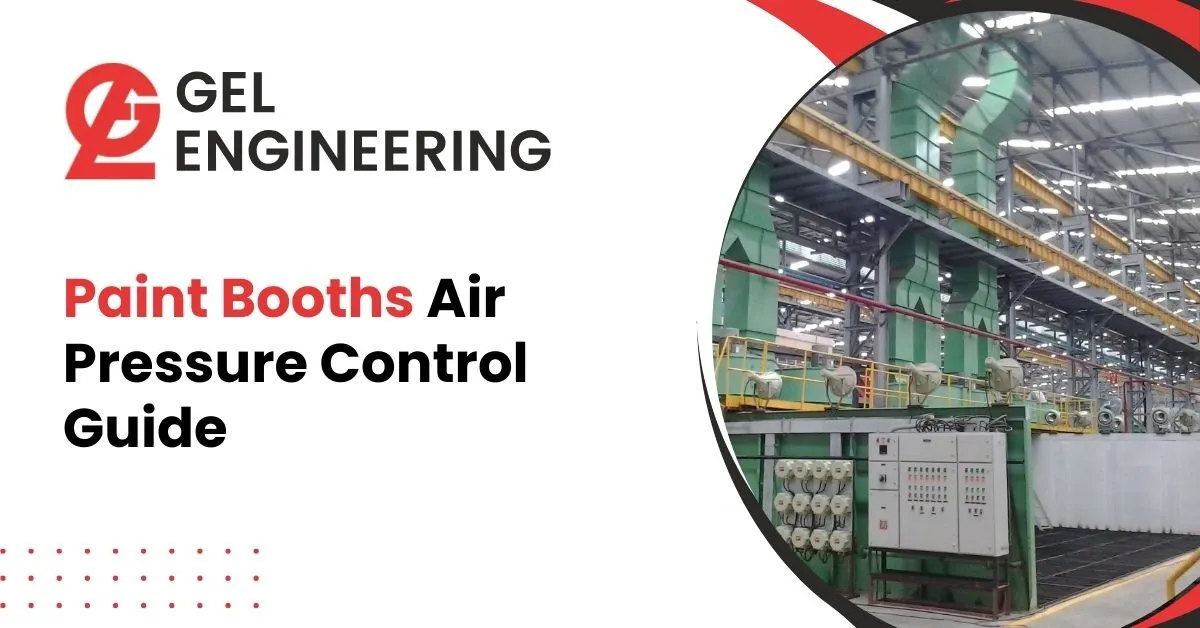
In industrial spray painting, finish quality depends not only on paint material and technique but also on airflow stability and pressure balance. Proper Paint Booth air pressure control ensures a dust-free environment, controlled overspray movement, improved coating adhesion, and enhanced worker safety.
Table of Contents
If the pressure inside a Paint Booth is not properly managed, it can lead to contamination, coating defects, paint wastage, and even regulatory non-compliance. This comprehensive guide explains everything you need to know about paint booth pressure systems, airflow control, ideal pressure settings, troubleshooting methods, and maintenance best practices.
Proper air pressure management directly impacts:
- Coating consistency
- Paint adhesion
- Worker safety
- Environmental compliance
- Production efficiency
What is Paint Booth Air Pressure?
In industrial coating operations, airflow must be carefully balanced to prevent dust intrusion and control overspray particles. A properly adjusted Paint Booth ensures that clean air flows smoothly across the painted object while contaminated air is safely exhausted.
Without correct air pressure control, the booth may experience turbulence, uneven coating thickness, or unsafe working conditions. Maintaining proper pressure levels improves production efficiency, reduces rework, and supports environmental compliance standards.
1. Positive Pressure Paint Booth
- Air supply is greater than exhaust.
- Prevents dust from entering the booth.
- Ideal for high-quality finishing applications.
2. Negative Pressure Paint Booth
- Exhaust airflow is greater than intake.
- Prevents fumes from leaking outside.
- Common in industrial containment systems.
3. Balanced Pressure Paint Booth
- Supply and exhaust airflow are equal.
- Maintains stable airflow conditions.
- Suitable for standard industrial operations.
Understanding the correct pressure type for your Paint Booth helps maintain coating quality and workplace safety.
Why Paint Booth Air Pressure Control is Important?
This pressure difference determines how air moves in and out of the Paint Booth during spray painting operations. It is typically measured using differential pressure gauges in inches of water column (in. WC) or Pascals (Pa).
Air pressure directly affects airflow speed, filtration efficiency, and overspray removal. When pressure is correctly balanced, the Paint Booth creates a controlled environment where coating quality remains consistent.
Improper pressure can cause:
- Dust contamination
- Overspray turbulence
- Poor paint adhesion
- Uneven coating thickness
- Increased paint defects
- Safety hazards
Maintaining proper pressure ensures smooth airflow across the painted object, reducing defects like orange peel, dry spray, and dirt nibs.
A properly balanced Paint Booth:
- Improves coating durability
- Enhances surface finish
- Protects workers from harmful fumes
- Reduces rework and production delays
Types of Paint Booth Pressure Systems
The Paint Booth pressure systems are designed based on airflow direction and contamination control requirements.
1. Positive Pressure Paint Booth
In a positive pressure Paint Booth, the supply air volume is slightly higher than the exhaust airflow.
Advantages:
- Prevents outside dust from entering
- Ideal for high-precision finishing
- Reduces contamination risk
Common Applications:
- Automotive painting
- Aerospace finishing
- Premium coating systems
2. Negative Pressure Paint Booth
In a negative pressure Paint Booth, exhaust airflow is slightly higher than intake airflow.
Advantages:
- Prevents fumes from escaping into facility
- Improves containment of VOCs
- Suitable for heavy industrial coating
Common Applications:
- Large industrial painting
- Chemical-based coatings
- Hazardous material environments
3. Balanced Pressure Paint Booth
A balanced Paint Booth maintains equal intake and exhaust airflow.
Advantages:
- Stable airflow pattern
- Reduced turbulence
- Energy-efficient operation
This setup is common in general manufacturing environments.
Why Paint Booth Air Pressure Control is Important?
Paint Booth air pressure control directly impacts coating quality, safety, and operational efficiency.
Improper air pressure can create several issues:
- Dust contamination on painted surface
- Uneven paint thickness
- Orange peel effect
- Overspray drifting
- Poor paint adhesion
- Increased paint consumption
Maintaining correct Paint Booth pressure ensures laminar airflow across the painted object. Smooth airflow prevents particles from settling and supports uniform coating application.
From a safety perspective, proper pressure control ensures harmful fumes are removed effectively, protecting workers from inhalation risks. It also ensures compliance with occupational safety standards and environmental emission guidelines.
Paint Booth Airflow and Pressure Control Components
Paint Booth air pressure control relies on multiple integrated components working together.
| Component | Function | Role in Pressure Control |
| Supply Fan | Pushes filtered air inside | Creates positive pressure |
| Exhaust Fan | Removes contaminated air | Maintains negative pressure |
| Dampers | Adjust airflow volume | Balances intake and exhaust |
| VFD (Variable Frequency Drive) | Controls fan speed | Fine-tunes pressure levels |
| Filters | Capture dust & overspray | Affect static pressure |
| Pressure Gauges | Monitor pressure levels | Ensure correct settings |
| Ducting System | Directs airflow | Maintains uniform distribution |
Each component must be properly maintained to ensure optimal Paint Booth air pressure control.
How Paint Booth Air Pressure Control Works?
A properly designed Paint Booth operates on the principle of controlled ventilation. The system ensures that clean air enters the booth, flows uniformly across the workpiece, and removes contaminated air efficiently. This airflow balance prevents dust contamination, improves coating quality, and maintains safe working conditions.
Step 1: Fresh Air Intake
Clean, filtered air enters the system through high-efficiency intake filters installed in the ceiling or intake plenum. These filters remove dust, dirt, and airborne particles before air reaches the interior of the Paint Booth.
Supply fans then push this filtered air into the booth at a controlled velocity. The volume of supply air directly influences whether the Paint Booth operates under positive, negative, or balanced pressure conditions.
Proper intake filtration ensures:
- Dust-free airflow
- Reduced contamination
- Stable pressure buildup
- Improved paint finish quality
Step 2: Controlled Airflow Circulation
Once inside the enclosure, air moves in a uniform direction depending on the Paint Booth design (crossdraft, downdraft, side draft, etc.). The airflow sweeps across the painted surface, carrying overspray particles and solvent vapors toward the exhaust section.
Consistent airflow is critical for:
- Maintaining uniform coating thickness
- Preventing turbulence
- Reducing paint defects
- Improving paint adhesion
In a properly balanced Paint Booth, airflow remains smooth and laminar, minimizing swirling air patterns that can disturb freshly applied coatings.
Step 3: Pressure Monitoring
Pressure gauges, such as magnehelic gauges or differential pressure meters, continuously measure the pressure difference between the inside of the Paint Booth and the surrounding environment.
Monitoring pressure helps operators:
- Detect clogged filters
- Identify airflow imbalance
- Prevent excessive negative or positive pressure
- Maintain ideal spray painting conditions
Regular pressure checks ensure that the Paint Booth operates within recommended pressure ranges for optimal performance.
Step 4: Airflow Balancing and Adjustment
If pressure readings move outside the desired range, technicians adjust airflow using dampers, variable frequency drives (VFDs), or fan speed controls.
Balancing airflow may involve:
- Increasing supply airflow to create positive pressure
- Increasing exhaust airflow to maintain negative pressure
- Adjusting dampers to fine-tune airflow volume
- Replacing clogged filters to restore proper airflow
Proper airflow balancing ensures that the Paint Booth maintains consistent internal pressure and prevents contamination or fume leakage.
Step 5: Continuous Regulation and Maintenance
Paint Booth air pressure control is not a one-time adjustment; it requires continuous monitoring and routine maintenance. Over time, filter loading, fan wear, and duct blockages can affect pressure levels.
To maintain consistent performance:
- Check pressure gauges daily
- Replace filters as per pressure drop guidelines
- Inspect fans and motors regularly
- Conduct airflow balancing periodically
Continuous regulation ensures that the Paint Booth delivers stable airflow, consistent coating quality, and safe working conditions throughout its operation.
Need help balancing your Paint Booth airflow and pressure settings? Contact us now to discuss your industrial airflow requirements.
Ideal Paint Booth Air Pressure Settings
Every industrial spray-painting setup has different airflow requirements. For example, automotive refinishing may require stricter contamination control compared to heavy equipment coating. Therefore, understanding the correct Paint Booth air pressure range is essential for achieving consistent and professional results.
Slight Positive Pressure for Dust-Free Finishing
In high-quality finishing environments, a Paint Booth often operates under slight positive pressure. This means the supply airflow is slightly higher than exhaust airflow. Positive pressure prevents outside dust, dirt, and contaminants from entering the booth, ensuring a cleaner painting environment.
Slight Negative Pressure for Fume Containment
In applications involving strong solvents or hazardous coatings, a Paint Booth may operate under slight negative pressure. In this setup, exhaust airflow is slightly higher than intake airflow. This prevents fumes and vapors from escaping into the surrounding workspace and enhances worker safety.
Face Velocity Around 50–100 Feet Per Minute (FPM)
Proper face velocity ensures that airflow moves smoothly across the painted surface without causing turbulence. Maintaining airflow within this range helps control overspray and ensures efficient contaminant removal. The exact velocity depends on Paint Booth design, size, and application type.
Regular Monitoring of Filter Pressure Drop
Filters play a critical role in maintaining airflow stability. As filters accumulate dust and overspray, static pressure increases. Monitoring filter pressure drop inside the Paint Booth ensures timely replacement and prevents airflow imbalance.
Common Paint Booth Pressure Problems and Solutions
Paint Booth pressure imbalance can cause serious performance issues, coating defects, safety risks, and reduced production efficiency. When airflow inside the booth is not properly balanced, it directly affects finish quality, overspray removal, and fume control. Even small pressure variations can lead to inconsistent coating results and increased paint wastage.
Understanding common Paint Booth air pressure problems and their solutions helps maintain stable airflow conditions and prevent costly downtime.
Problem 1: Excessive Negative Pressure
Cause:
- High exhaust fan speed
- Restricted or clogged intake filters
- Insufficient supply airflow
- Blocked intake ducts
When exhaust airflow is significantly higher than intake airflow, the Paint Booth operates under excessive negative pressure. This can draw dust and contaminants from surrounding areas into the booth through gaps or openings.
Problem 2: Excessive Positive Pressure
Cause:
- Blocked or clogged exhaust filters
- Reduced exhaust fan performance
- Oversized supply airflow
- Dirty exhaust ducts
When supply airflow is much higher than exhaust airflow, the Paint Booth experiences excessive positive pressure. This can create turbulence and prevent proper removal of overspray particles.
Problem 3: Uneven Airflow Distribution
Cause:
- Damaged or leaking ductwork
- Improperly adjusted dampers
- Obstructed airflow paths
- Incorrect fan calibration
Uneven airflow inside the Paint Booth can create “dead zones” where air circulation is poor. This disrupts overspray removal and may cause inconsistent coating thickness.
Problem 4: High Static Pressure
Cause:
- Dirty intake filters
- Overspray-loaded exhaust filters
- Clogged ducting
- Poor maintenance schedule
High static pressure inside a Paint Booth indicates restricted airflow, usually due to filter blockage. As filters collect dust and overspray particles, resistance increases, affecting overall performance.
How to Measure Paint Booth Air Pressure?
Accurate pressure monitoring allows operators to detect airflow imbalance, clogged filters, and ventilation inefficiencies before they affect production. Regular measurement of Paint Booth air pressure ensures that the system operates within recommended pressure ranges and maintains stable internal conditions for industrial spray painting.
Common tools include:
- Magnehelic gauges
- Differential pressure meters
- Manometers
- Air velocity meters
Routine pressure measurement helps detect filter clogging, airflow imbalance, and system inefficiencies early.
Frequently Asked Questions
What should the air pressure be in a paint booth?
A Paint Booth should maintain slight positive or slight negative pressure depending on application, typically monitored using differential pressure gauges.
Why is air pressure important in a paint booth?
Air pressure ensures proper airflow, prevents contamination, and improves coating consistency.
How do you control paint booth air pressure?
Air pressure is controlled by adjusting supply and exhaust fans, dampers, and monitoring pressure gauges.
What happens if paint booth pressure is too high?
Excessive pressure can cause turbulence, uneven coating, and overspray issues.
How often should paint booth pressure be checked?
Paint Booth pressure should be checked daily or before each production shift.
Conclusion
Paint Booth air pressure control is a critical factor in achieving high-quality industrial spray painting results. Proper pressure management ensures dust-free environments, consistent coating performance, worker safety, and regulatory compliance. Whether using positive, negative, or balanced pressure systems, maintaining the right airflow balance inside a Paint Booth improves productivity, reduces defects, and enhances overall coating efficiency. By implementing regular monitoring, proper maintenance, and airflow balancing, industries can optimize their Paint Booth performance and achieve reliable, professional finishing results.
Related Posts